|
|

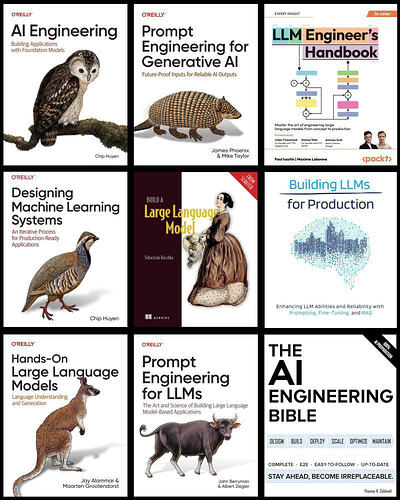
AI Engineering: Building Applications with Foundation Models
by Chip Huyen: This book is frequently cited as a foundational text, covering the process of building applications using readily available foundation models and how it differs from traditional ML engineering.
Designing Machine Learning Systems: An Iterative Process for Production-Ready Applications
by Chip Huyen: Often considered complementary to the above, this book focuses on designing scalable, reliable, and maintainable ML systems, from data handling to deployment and monitoring.
LLM Engineer’s Handbook: Master the Art of Engineering Large Language Models from Concept to Production
by Paul Iusztin & Maxime Labonne: This book offers practical guidance and “recipes” for moving Large Language Model (LLM) projects from prototype to production.
Hands-On Machine Learning with Scikit-Learn, Keras, and TensorFlow
by Aurélien Géron: Praised for its practical approach, this guide covers core ML and deep learning concepts with real-world examples and popular Python libraries.
Build a Large Language Model (From Scratch)
by Sebastian Raschka: This book is recommended for gaining a deep, fundamental understanding of how LLMs work internally by building one from the ground up.
Deep Learning
by Ian Goodfellow, Yoshua Bengio, and Aaron Courville: Often referred to as the “bible” of modern AI foundations, this provides a comprehensive mathematical and conceptual background for deep learning.
Prompt Engineering for LLMs
by John Berryman & Albert Ziegler: These titles cover techniques for optimizing prompts and model outputs, a critical skill in modern AI development.
The AI Engineering Bible
by Thomas D. Caldwell: Positioned as a comprehensive reference for contemporary AI engineering practices.
Designing Data-Intensive Applications
by Martin Kleppmann: Though not exclusively an AI book, it is highly recommended for building scalable and reliable data systems, which is crucial infrastructure for production AI.
下载地址:
|
|

 |本站内容来源网友投稿或网络转载,如果有侵权的内容,请联系我们删除。|小黑屋|人人为我,我为人人!|
星颖资源网
|本站内容来源网友投稿或网络转载,如果有侵权的内容,请联系我们删除。|小黑屋|人人为我,我为人人!|
星颖资源网




 发表于 2025-12-10 14:28:27